Introduction: Why Businesses Can No Longer Ignore the Digital Shift
Every industry today is faced with a basic fact. You either get on board with technology or your competition will pass you by. Companies that keep using old systems lose consumers, squander resources, and miss development possibilities. Digital transformation in India has acquired real steam in the past several years, with organizations across industries searching for better, quicker, and more efficient methods of doing business. But what does digital transformation entail for your organization, and where do you start? This article tells you everything.
What Is Digital Transformation?
Digital transformation is the use of current digital technologies to replace conventional or obsolete corporate processes. It covers everything from cloud adoption to mobile apps to data analytics to automation and bespoke software solutions. The aim is not only to become digital. The aim is to create a firm that works smarter, serves its customers better, and grows frictionlessly.
This transformation involves all departments, from sales and marketing to operations and customer support. Done well, it innovates how a firm produces value and remains competitive in a saturated market.
What Does a Digital Transformation Solution Include?
A comprehensive digital transformation solution spans numerous levels of your company’s activities. Here is a simple summary of the key elements:
| Component | What It Does |
| Custom Software Development | Develops tools specific to your company processes |
| Mobile Application Development | Delivers your services right to your customers’ hands |
| Cloud and DevOps | Relocates infrastructure to the cloud for improved speed and dependability |
| Enterprise Application Development | Connects departments via shared systems |
| API Management | Allows diverse platforms and technologies to connect |
| Software Testing and QA | Makes sure every solution works without fail |
Each component works in harmony to build a technological ecosystem that promotes long-term company development and eliminates operational risk.
What Are the Key Benefits of Digital Transformation for Businesses?
Companies that embark on a thorough transformation get benefits in numerous areas. The most popular advantages are the following:
- Real-time data and analytics for quicker decision-making
- Reduce operational cost by automating repetitive jobs
- Personalized digital touchpoints to improve client experience
- Integrated platforms facilitate better team collaboration
- More scalability without equivalent increases in cost or personnel
But these advantages aren’t only for big firms. When partnering with the proper technology partner from the very beginning, small and mid-size organizations get the same benefits.
Which Industries Benefit the Most from Digital Transformation Services and Solutions?
The quick answer is every industry. But the greatest immediate effect is in some areas. Digital transformation services and solutions have already transformed healthcare, retail, education, manufacturing, transportation, and media.
Now, people may connect with physicians remotely using telemedicine systems in healthcare. In the retail space, mobile applications and e-commerce platforms provide companies with a direct line to their consumers. In manufacturing, smart software monitors production lines and sends alerts to problems before they create expensive downtime.
The unifying denominator of all these areas is the demand for specialized, scalable technology. Off-the-shelf tools seldom meet complicated company demands. That’s where purpose-built solutions come in, and this is why more organizations are increasingly investing in specialist technology partners and not generic software packages.
How Can Digital Transformation Companies Help Businesses Make the Transition?
Most firms don’t have the technological know-how on board to do a complete digital transformation by themselves. That is where digital transformation companies step in. These organizations analyze your present processes, detect gaps, suggest the proper technology, and create solutions that suit your unique company model.
A good IT partner does not simply write code. They understand your company’s objectives and provide solutions that address genuine difficulties. Dynamic Methods brings end-to-end services across web application development, mobile applications, custom software, cloud, DevOps, and software testing. With offices in India and Canada and over 399 satisfied clients, their approach focuses on open communication, well-defined milestones, and end products that consistently exceed expectations across healthcare, retail, manufacturing, and education.
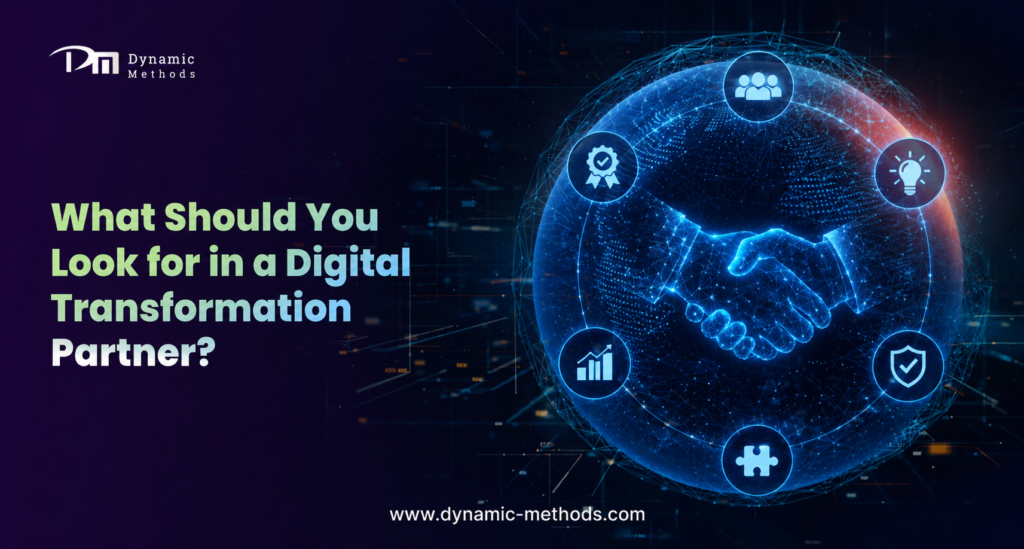
What Should You Look for in a Digital Transformation Partner?
The proper technology partner is just as important as the correct technology. Before signing up with any firm, you should assess these major factors:
- Extensive experience and success in numerous sectors and kinds of projects
- End-to-End Service Suite for Software, Mobile, Cloud, and Quality Testing
- Open communication and well-defined project milestones
- Client testimonials showing consistent delivery and high standards
- A team that will take time to learn your company before offering solutions
A bad partner may squander months of your time and a big chunk of your finances. The perfect one is a true extension of your own staff and a long-term benefit for your firm.
Conclusion: Take the First Steps to Change
Digital transformation is never a one-time effort. It is a dedication to improved systems, smarter procedures, and stronger customer connections. Companies that act now get a significant competitive advantage. Those who delay will pay a larger price later, in lost income and costly catch-up initiatives. Digital transformation in India continues to grow as a strategic priority for businesses of every size, and the right technology partner can make all the difference. Dynamic Methods has the experience, the track record, and the cross-industry expertise to help your business make that shift smoothly and successfully.
FAQ
Q1. What is the difference between digital transformation and digitization?
Digitisation is the process of transforming physical documents into a digital version. Digital transformation is a more comprehensive approach using technology to alter how your whole organization runs and offers value to consumers.
Q2. What is the normal duration of a digital transformation project?
The time frame depends on the scope. A single mobile app or software tool may take three to six months, whereas a comprehensive corporate transformation spanning many systems might take 1-2 years.
Q3. Do you think digital transformation is for big companies only? No.
Small and medium-sized enterprises profit just as much. Custom software and mobile solutions may help you enhance productivity and customer experiences, whether you’re a small company or a large corporation.
Q4. Which technologies are most prevalent in digital transformation?
Some of the most often utilized technologies include cloud platforms, mobile apps, APIs, automation tools, data analytics software, and enterprise resource planning systems.
Q5. What are the signs that my firm is ready for digital transformation?
If your company procedures are inefficient, error-prone, or cannot scale up with demand, you are already a prime candidate. A technology partner may examine your position and offer the correct way ahead.


 INDIA OFFICE
 CANADA OFFICE