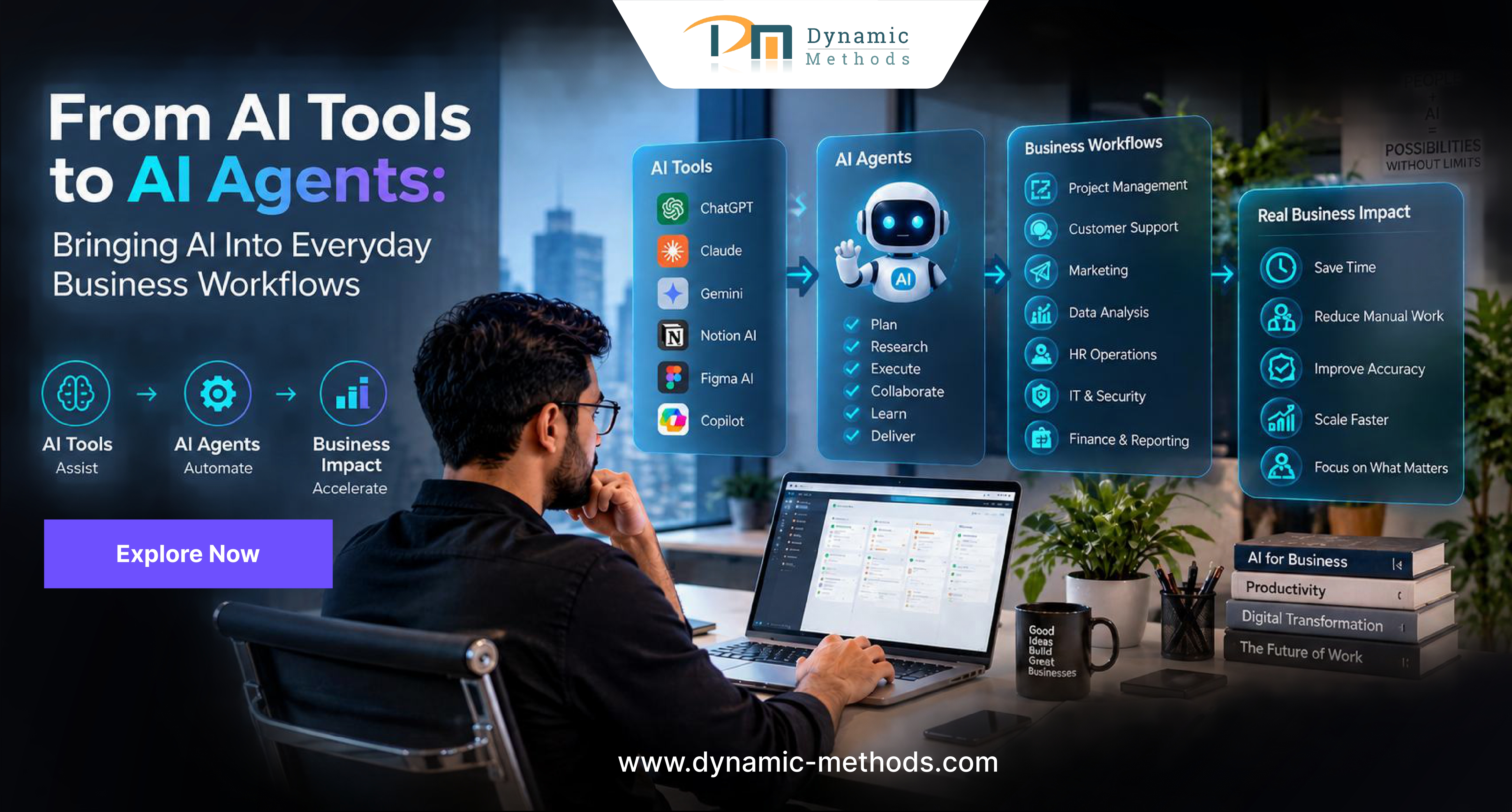
Most businesses got their first taste of AI through simple tools. A chatbot that answers basic questions. A writing assistant that drafts an email. These tools do one job, then stop and wait for the next command. That model has limits. AI agent development takes things further. It gives software a goal, lets it plan the steps needed, and lets it act across a full task without a person guiding each move. For a business tired of babysitting every small step, this changes how work actually gets done, from replying to customers to pulling together weekly reports.
What Is the Real Difference Between AI Tools and AI Agents?
A tool does one thing and hands the result back to a person. Someone checks it, decides what comes next, then types a fresh instruction. Fine for a small job. Painful once the volume grows.
An agent works differently. It holds a goal in mind. It breaks that goal into steps. It pulls data from other systems when it needs to, and it adjusts course when something changes along the way. That is the appeal behind AI agents for business: one piece of software can carry a task from start to finish, and a person only steps in to check the outcome or fix a mistake.
Why Are Companies Moving Toward AI Agent Development?
Manual work costs money. Every hour a staff member spends copying data between two systems is an hour they do not spend talking to a customer or solving a real problem. Businesses want that time back, and they want whole processes handled, not just single tasks. That demand explains why AI agent development has picked up pace across retail, healthcare, finance and plenty of other sectors.
Companies that hire out AI agent development services gain something a basic tool cannot give them. They get software that keeps context across a task, links to internal systems on its own, and finishes multi step work without someone standing over it. Fewer bottlenecks. Faster turnaround. Less admin drag on the people who actually run the business.
Where Do AI Agents Fit Into Everyday Workflows?
Agents work best on jobs that involve several steps and a few decisions along the way. A handful of real examples:
- Customer support: an agent reads a query, checks the order history, issues a refund or passes the case to a person, all without someone typing every reply
- Finance teams: an agent matches invoices, flags anything that does not add up and puts together a report ready for review
- HR departments: an agent screens applications, books interview slots and sends the follow-up notes
- Sales teams: an agent updates records, ranks leads by priority and drafts an outreach message based on recent account activity
Each of these shows AI workflow automation at work. Instead of a person switching between five apps to finish one task, a single agent runs the whole sequence and only raises a hand when something looks off. This is also where intelligent workflow automation earns its name. The agent does not just follow a fixed script. It reacts to whatever data lands in front of it.
How Does AI Workflow Automation Improve Team Efficiency?
Staff lose real hours each week to admin that adds no strategic value at all. Once AI workflow automation takes that load, the team gets that time back for the parts of the job that actually need a human brain: client relationships, planning, and problem-solving.
Speed is not the only win here. Intelligent workflow automation also cuts down on the small errors that creep in when a person juggles several manual steps under time pressure. Firms that bring in AI automation services for their back office work often notice cleaner records, quicker approvals and far fewer arguments with clients or suppliers over mistakes that should never have happened.
What Should Businesses Look for in AI Integration Services?
Dropping an agent into a business is not as simple as flipping a switch. It has to connect with the systems already in place, respect the data rules a company follows and fit how the team actually works day to day. Solid AI integration services cover a few things without fail:
- A proper look at current systems before anything goes live
- Secure links to the CRM, the accounting software and the tools staff already use to talk to each other
- Testing under real conditions, not just a tidy demo built to impress
- A backup plan in case an agent needs changes once it is live
Skip this groundwork, and a business ends up with an agent that cannot talk to the rest of the company properly. That is exactly why enterprise AI need proper planning from day one rather than a rushed launch chasing a trend.
How Do Enterprise AI Solutions Support Long-Term Growth?
A small pilot has its place, but the real payoff shows up once enterprise AI solutions run across more than one department. One agent handling support tickets helps. Ten agents working together across support, billing and logistics change how the whole business runs.
This is the point where AI agents for business stop being an experiment and start acting as proper infrastructure. As agents settle into a company, AI agent development turns into an ongoing job rather than a project with an end date, with teams tweaking agent behaviour as processes shift and customer needs change.
What Does Practical AI Agent Development Look Like for a Business?
A sensible rollout rarely starts with a company-wide overhaul. It starts with one process that causes real pain: slow invoice approvals, say, or the same customer question landing in the inbox fifty times a week. A business tests an agent on that one problem, checks the results, then expands once the case proves itself.
Companies without the skills in-house often turn to a specialist partner for AI agent development services, since building this capability from scratch eats up time most teams simply do not have. Agencies that offer AI automation services alongside broader software work, Dynamic Methods among them, tend to handle this well because they already know how to connect new technology to the systems a business already runs. The same goes for AI integration services. A brilliant agent tied badly to the rest of the business still causes friction rather than removing it, so this part of the job matters just as much as the agent itself.
Conclusion
The shift from single-purpose tools to proper agents is a real change in how businesses run day-to-day, not just another buzzword on a slide. Companies that treat AI agent development as an ongoing project, rather than a quick experiment to try once and forget, tend to see the clearest gains: faster work, fewer mistakes, and staff time freed up for jobs that actually need a person. Firms such as Dynamic Methods, already working across software development and digital projects, offer a useful example of how this shift plays out in practice, tying new agent capability to the systems a business already depends on.
FAQs
1. What is the simplest way to explain an AI agent to someone new to the topic?
Picture a tool as a single button and an agent as a small assistant who presses several buttons in the right order to get a job finished.
2. Do small businesses actually need AI agents, or is this only for large enterprises?
Small businesses gain too, especially for repeat tasks like booking confirmations or chasing overdue invoices, where even one agent frees up hours a week.
3. How long does it take to get an AI agent working inside a business?
A focused pilot on one process can go live within a few weeks. A wider rollout across several departments usually takes a few months.
4. Is it risky to let an AI agent make decisions without a person checking every step?
Most businesses start with a person approving key actions, then hand over more independence once the results stay consistent and trust builds.
5. What is the first step a business should take before it adopts AI agents?
Find one process that keeps causing delays or mistakes. That gives a clear, low-risk starting point for the first agent trial.


 INDIA OFFICE
 CANADA OFFICE