
Author name: Vikash Parihar

Vikash Parihar is Dynamic Methods' Business Development Manager, leveraging 10 years of industry experience. His forward-thinking strategies and effective networking contribute significantly to our business growth and expansion.

vikash parihar
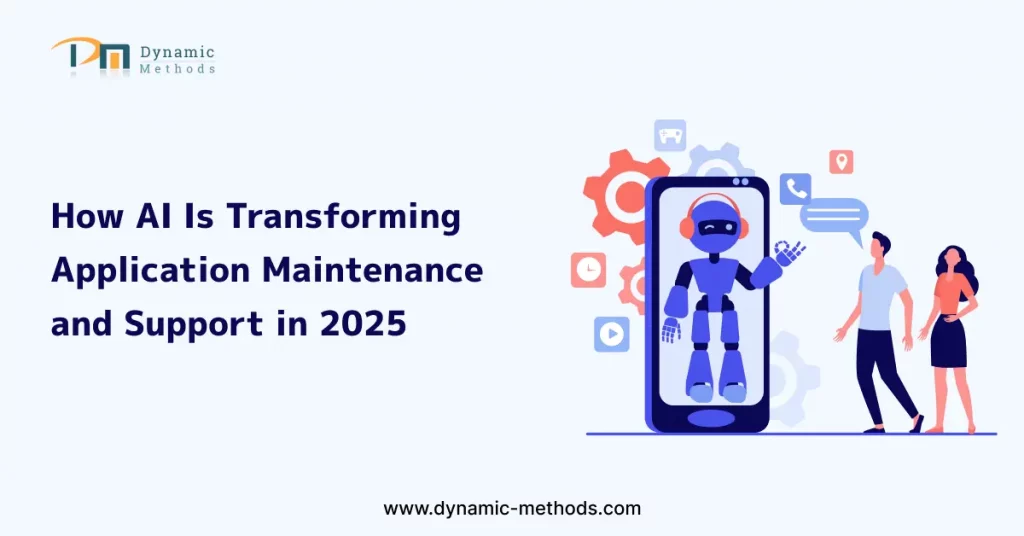
Illustration showing how AI is transforming application maintenance and support in 2025, with a robot on a smartphone screen and two people standing nearby, representing AI-driven technology by Dynamic Methods.

How AI Is Transforming Application Maintenance and Support in 2025

Illustration showing how AI is transforming application maintenance and support in 2025, with a robot on a smartphone screen and two people standing nearby, representing AI-driven technology by Dynamic Methods.

“The future belongs to those who prepare for it today.” – Malcolm X. In a digital-first world, businesses run on applications. From customer-facing platforms to backend enterprise systems, applications drive efficiency, user experience, and growth. 

But maintaining these applications has never been simple; bug fixes, performance issues, downtime, and growing user demands make application maintenance and support a critical yet challenging function.

Now, enter Artificial Intelligence (AI). By 2025, AI will no longer be just a buzzword; it will have become a game-changer for IT operations, reshaping how organizations approach Application Maintenance Services. Whether it’s predictive monitoring, automated bug detection, or intelligent ticket resolution, AI is bringing unmatched speed, accuracy, and cost savings to this space.

So, how exactly is AI transforming application maintenance and support, and why should businesses pay attention? Let’s dive deeper.

1. From Reactive to Proactive Support

Traditionally, IT teams worked reactively. An application issue occurred → the system went down → users complained → support teams scrambled to fix it. This reactive cycle often led to customer frustration, revenue loss, and longer downtimes.

AI changes this dynamic. With predictive analytics and machine learning, AI can detect anomalies and predict failures before they happen. Imagine receiving an alert about a potential server crash hours before it occurs. Instead of firefighting, IT teams can prevent downtime altogether.

This proactive approach not only reduces disruptions but also improves user satisfaction, a win-win for businesses and customers.

2. Automated Bug Detection and Resolution

Every business knows the pain of bugs, small glitches that can lead to massive problems. Manually identifying and resolving bugs is time-consuming, error-prone, and often expensive.

AI-powered tools can now scan millions of lines of code in minutes, identifying anomalies, inefficiencies, and potential risks. What once took weeks can now be achieved in hours. Even better, AI-driven solutions are starting to self-heal applications, automatically fixing minor bugs without human intervention.

This automation allows IT teams to focus on innovation rather than repetitive maintenance tasks, driving higher productivity.

3. Smarter Ticket Management with AI Chatbots

Support tickets are the backbone of application maintenance, but they often pile up, overwhelming IT helpdesks. AI is redefining ticket management through intelligent chatbots and virtual assistants.

Instead of waiting for human agents, users can interact with AI-powered assistants that provide instant resolutions to common issues. These chatbots can triage requests, classify tickets, and even escalate complex cases to the right human experts, all while learning and improving over time.

The result? Faster ticket resolution, reduced response times, and happier users.

4. Cost Savings Through Intelligent Resource Allocation

Application maintenance and support are expensive. Hiring specialized staff, managing complex systems, and addressing unexpected outages all contribute to rising costs.

AI helps by optimizing resource allocation. For example, AI can analyze historical data to predict peak usage times and allocate IT resources accordingly. It can also recommend the most efficient way to distribute workloads, reducing unnecessary expenditures.

According to industry reports, businesses using AI in their Application Maintenance Services have already seen cost savings of up to 30%. That’s not just an improvement, it’s a competitive advantage.

5. Improved Security and Compliance

Security breaches are among the biggest threats to businesses today. Applications that are poorly maintained are prime targets for cybercriminals.

AI is playing a vital role in enhancing application security. Machine learning algorithms can detect unusual behavior, flag suspicious logins, and monitor transactions in real time. AI can even suggest patches and updates before vulnerabilities are exploited.

For businesses that operate in regulated industries, AI-driven compliance monitoring ensures applications meet industry standards without overwhelming IT teams with manual checks.

6. Personalized User Experience

Beyond technical support, AI is also enhancing the end-user experience. Applications maintained with AI-driven insights can deliver more personalized and seamless interactions.

For instance, AI can track how users interact with an app, predict their needs, and proactively recommend solutions. This doesn’t just keep the application running smoothly; it strengthens brand loyalty by making users feel valued and understood.

7. The Human + AI Collaboration

It’s important to remember that AI doesn’t replace humans; it empowers them. Application maintenance is complex, and while AI handles repetitive tasks, humans bring creativity, strategy, and empathy.

The most successful IT teams in 2025 will be those who leverage AI as a partner, not a replacement. This human-AI collaboration ensures businesses achieve both efficiency and innovation.

Real-World Example

Take the case of global enterprises adopting AI-driven maintenance. A leading financial services company reported that by deploying AI-powered predictive monitoring, they reduced downtime by 40% and saved millions annually in IT costs.

This isn’t just theory; AI in application maintenance and support is delivering measurable business results worldwide.

What Businesses Should Do in 2025

The earlier you integrate AI into your maintenance strategy, the stronger your competitive edge will be. If you’re still relying on manual processes for maintenance and support, you’re already falling behind. Here are a few steps to get started:

  1. Assess your current application landscape – Identify repetitive tasks that can be automated.
  2. Invest in AI-powered tools – From monitoring to ticket management, explore AI-driven platforms.
  3. Upskill your IT teams – Train staff to work alongside AI, not against it.
  4. Start small, scale fast – Begin with pilot projects and expand once results are proven.

Wrapping Up

Application maintenance and support is no longer just about keeping the lights on; it’s about driving business growth, ensuring reliability, and delighting customers. AI is making this possible by transforming outdated, reactive processes into intelligent, proactive solutions.

As businesses step into the future, those who embrace AI in Application Maintenance Services will enjoy faster response times, reduced costs, and improved customer satisfaction.

At Dynamic Methods, we believe the future of IT lies in blending human expertise with AI-driven innovation. The organizations that adapt today will be the leaders of tomorrow.

So, are you ready to transform your applications with AI?

How AI Is Transforming Application Maintenance and Support in 2025 Read More »

Illustration of AI integration in web development with a robot and magnifying glass on a computer screen.

How to Integrate AI in Web Development in 2025

Did you know there are over 1.5 billion websites on the internet, and thousands of them offer products or services almost identical to yours? That means just coding and launching a website is not enough to stand out anymore.

Today, digital transformation demands creativity, speed, and personalisation. And this is where Artificial Intelligence (AI) is changing the game. Partnering with a web development company in India can help businesses take advantage of AI tools and strategies to stand out in 2025.

As one popular quote says: “AI is not here to replace humans, it’s here to amplify human potential.”

In this blog, we’ll explore how AI is reshaping web development, practical ways to integrate it into web apps, and why working with an experienced software development company in India can help businesses unlock its full potential.

What Exactly Is AI in Web Development?

Artificial Intelligence simply means machines simulating human intelligence, learning, reasoning, problem-solving, and adapting. This means web apps are no longer static; they’re becoming smart, adaptive, and user-friendly.

In web development, AI goes beyond traditional coding. It helps websites and applications:

  • Understand user behaviour
  • Offer personalised experiences
  • Automate tasks like testing or debugging
  • Strengthen security
  • Speed up decision-making with data

Why Use AI in Web Development in 2025?

AI-powered websites don’t just look modern, they deliver real business value. Let’s break down the major benefits.

  1. Personalised User Experiences
    AI analyses browsing patterns, clicks, and user journeys. For example, e-commerce sites can recommend products, while news portals highlight stories tailored to each visitor. This level of personalisation increases conversions and customer loyalty.
  2. Smarter Communication with Chatbots
    AI-powered chatbots and voice assistants offer 24/7 customer support. They handle FAQs, book appointments, and even process orders, reducing workload and improving customer trust.
  3. Intelligent Automation
    AI automates repetitive tasks like testing, debugging, and SEO monitoring. This not only saves developer time but also improves accuracy by reducing human error.
  4. SEO and Better Rankings
    AI-driven tools study algorithms, keywords, and competition. They recommend content updates, track rankings, and optimise sites for search engines. That’s why AI-powered sites are more likely to rank higher in 2025.
  5. Data-Driven Decision Making
    AI turns raw data into actionable insights. From predicting customer behaviour to optimising marketing campaigns, it helps businesses make smarter choices.

How to Integrate AI Into Web Apps

If you’re thinking AI integration is complicated, here’s the truth: any business can do it with the right tools and expertise. Let’s look at the most practical ways.

AI in Front-End Development

  • Chatbots & Virtual Assistants: Add conversational agents to guide users.
  • Voice User Interfaces: Make your web app accessible with voice commands.
  • Image & Video Recognition: Auto-tag content, recommend visuals, and enhance search.
  • AI-Powered Design: Tools like Adobe Firefly suggest layouts, colours, and themes.

AI in Back-End Development

  • Natural Language Processing (NLP): Understand and process user input for smarter interactions.
  • Automated Testing & Debugging: Tools like Testim or DeepScan detect bugs instantly.
  • Resource Optimisation: AI distributes computing power based on user traffic.
  • Enhanced Security: AI detects suspicious activity and blocks threats in real-time.

Whether front-end or back-end, AI integration ensures your site stays fast, secure, and future-ready. Many companies rely on application development services to make this process seamless.

Role of a Web Development Company in India

Why are so many global businesses choosing a web development company in India for AI projects? Similarly, a trusted software development company in India provides end-to-end application development services from building AI-powered chatbots to integrating recommendation engines or predictive analytics.

Because India offers:

  • Expert developers skilled in AI, ML, and web technologies
  • Cost-effective solutions without compromising quality
  • Scalable services designed for startups and enterprises alike
  • Global experience serving diverse industries

Real-World Examples of AI in Web Development

To understand the impact, let’s see how industries already use AI in 2025. The following examples prove that AI isn’t limited to big corporations; small and medium businesses can leverage it too.

  • E-commerce: Amazon and Flipkart recommend products based on user activity.
  • Healthcare: AI chatbots help patients book appointments and answer basic health questions.
  • Finance: Apps like Mint analyse spending habits and give budgeting advice.
  • Education: Platforms create adaptive learning experiences tailored to each student.

Common Myths About AI in Web Development

  • “AI is too complex for small businesses.” → Not true. Ready-to-use APIs and frameworks make integration easier than ever.
  • “AI will replace developers.” → AI assists developers but doesn’t replace creativity, strategy, and human touch.
  • “AI is only for large enterprises.” → Even startups now use AI-powered tools for SEO, chatbots, and analytics.

The Future of AI-Powered Web Apps

The takeaway? Businesses that adopt AI early will lead the digital race, while others risk falling behind. By 2025 and beyond, expect AI to push web development further with:

  • Websites that predict user needs before they ask
  • Automated content creation tailored to audiences
  • Voice-first browsing experiences
  • More advanced AI design tools are generating layouts automatically

Wrapping Up

Artificial Intelligence is no longer just a tech buzzword; it’s becoming the backbone of modern web development. From personalisation and automation to SEO and security, AI is transforming how web apps are built and used.

If you want to embrace these benefits, partnering with a skilled web development company in India or a reliable software development company in India is the smartest move. 

With the right application development services, your business can stay competitive, deliver exceptional user experiences, and grow faster in 2025.

This is precisely what Dynamic Methods focuses on: helping businesses implement AI for smarter, more future-ready applications.

How to Integrate AI in Web Development in 2025 Read More »

Illustration of a balanced scale comparing cost (represented by a dollar sign) and quality (represented by a shield with a checkmark), under the title "Cost vs Quality: Choosing the Right Offshore Development Partner" by Dynamic Methods

Cost vs Quality: Choosing the Right Offshore Development Partner

Illustration of a balanced scale comparing cost (represented by a dollar sign) and quality (represented by a shield with a checkmark), under the title "Cost vs Quality: Choosing the Right Offshore Development Partner" by Dynamic Methods

Businesses are constantly under pressure to deliver innovative software solutions in a timely and cost-effective manner in the fast-paced digital world of today. Many businesses now recognize that offshore development is the best way to meet these demands. But when choosing the best offshore development partner, one important question arises: Should you prioritize cost or quality?

Let’s examine how to properly balance the two and what to look for when choosing a trustworthy offshore partner for web application development, application development services, and custom software development.

Why Offshore Development?

Offshore development gives companies access to highly skilled talent from all over the world. This strategy is attractive because it lowers operating expenses, speeds up project completion, and focuses internal teams on important business functions.

Not all offshore companies provide the same quality of services, although they have an obvious cost advantage. Choosing a partner who offers both price and quality is now the real challenge.

The Cost Factor: What Are You Really Saving?

Offshore development gives companies access to highly skilled talent. Saving money is the primary reason why many businesses search abroad. Countries like India, the Philippines, Ukraine, and Vietnam offer development services at lower hourly rates than the US, Canada, or Western Europe. These savings can add up, especially for startups or mid-sized businesses with limited resources.

However, cheap does not always translate to high quality. Selecting a partner only based on cost could have unanticipated consequences such as:

  • Poor code quality
  • Missed deadlines
  • Communication gaps
  • Lack of documentation
  • Higher long-term maintenance costs

In the end, what you save upfront might cost you more in rework, delays, or system failures.

The Quality Factor: Investing in the Right Expertise

On the other hand, a key element of successful digital products is quality. Well-developed software is reliable, scalable, and user-friendly. This is especially important for businesses looking for custom software development or complex web application development projects. Reliable partners don’t just build software; they contribute to your product’s success.

Here’s what high-quality offshore development looks like:

  • Clean, well-structured code
  • On-time delivery
  • Clear and regular communication
  • Deep understanding of your business needs
  • Long-term technical support and scalability

Cost vs Quality: It’s Not Always a Trade-Off

Even though many businesses feel they have to pick between quality and cost, the best offshore development partners offer both. Avoid sacrificing one for the other; striking the correct balance is crucial.

A few of the offshore businesses have developed into quite competent service providers. They offer affordable application development services without sacrificing quality. Their development teams are knowledgeable, methodical, and committed to achieving results.

So, how do you identify such a partner?

Tips for Choosing the Right Offshore Development Partner

Here are some essential tips to help you make a smart decision:

1. Evaluate Technical Expertise

Look for a partner with proven experience in custom software development and web application development. Check their portfolio, case studies, and client testimonials. The right team should have a strong grasp of the technologies your project needs.

2. Consider Communication Skills

Effective communication is crucial. Choose a partner who is responsive, speaks English (or your preferred language), and is available throughout your working hours. Poor communication can lead to misunderstandings and delays.

3. Check Development Processes

Ask about how they handle development. Do they follow agile methodologies? How do they manage QA, testing, and sprints? A professional offshore team will take a structured approach.

4. Assess Cultural Compatibility

Collaboration may be impacted by cultural differences. Verify if expectations, values, and work ethics are all in line. Smoother and more productive professional relationships can result from a good cultural match.

5. Start Small, Then Scale

Start with a small project or pilot if you’re not sure. Before committing to a larger engagement, this allows you to assess their performance.

Red Flags to Watch Out For

While searching for the right offshore partner, be cautious of:

  • Teams that agree to everything without asking questions
  • Unrealistically low pricing
  • No clear project roadmap or timeline
  • Limited or no client references
  • Poor online presence or outdated website

These could be signs that the provider lacks the depth or professionalism required for your project.

The Importance of a Long-Term Relationship

Treat your partner like an extension of your team once you’ve found someone who can provide both quality and cost-effectiveness. Deeper cooperation, improved product expertise, and more efficient development cycles might result from a long-term partnership.

Building a website or an app isn’t the only objective. It is to develop a digital product that is scalable and will help you achieve your business objectives for many years to come. That calls for trust, openness, and constancy.

Wrapping Up

Comparing hourly rates is not the only factor to consider when selecting an offshore development partner. It all comes down to selecting a group that shares your vision, meets your budget, and does excellent work.

You don’t have to choose between price and quality if you do your homework and set clear priorities. Whether you require flexible custom software development, modern web application development, or end-to-end application development services, the correct offshore partner can help you succeed effectively and affordably.

At Dynamic Methods, we specialize in helping businesses find the perfect balance between cost and quality.

Need help finding the right development partner?

Work with a team that delivers high-quality digital solutions without stretching your budget. Let’s build something great together.


Cost vs Quality: Choosing the Right Offshore Development Partner Read More »

Illustration of SaaS product growth with graph and developers – Guide on building a scalable SaaS platform from MVP to a full-fledged solution

How to Build a Scalable SaaS Product: From MVP to Growth-Ready Platform

Illustration of SaaS product growth with graph and developers – Guide on building a scalable SaaS platform from MVP to a full-fledged solution

Introduction: Building SaaS that Scales with You

The Software-as-a-Service (SaaS) model continues to dominate the digital product landscape—powering everything from startups to enterprise platforms. But while launching a Minimum Viable Product (MVP) is often quick and lean, scaling it into a full-featured, growth-ready platform is where the real challenge begins.

Scalability isn’t just about server load—it’s about building a system, product, and team that can grow with your users, meet future demands, and maintain performance, reliability, and usability without needing constant reinvention. Moreover, scalability should not be on the cost of user’s experience and availability of the software.

In this comprehensive guide, we’ll walk through how to take your SaaS product from a scrappy MVP to a powerful, scalable platform that delights customers, attracts investors, and drives consistent growth.

Step 1: Validating the Idea and Building a True MVP

Before scalability, comes viability.

An MVP isn’t about rushing a half-baked product to market. It’s about delivering the core value proposition with the least amount of effort, but with enough to validate your assumptions. MVP should be well validated and aligned with the end user’s need and requirement, it doesn’t mean non-functional or useless porotype which cultivate no end result. 

Define a Real Problem to Solve

Start by understanding your users’ real frustrations:

  • What process is manual, outdated, or fragmented?
  • What task are they overpaying for?
  • What work is being done with duct-tape solutions?

Examples of strong MVPs:

  • A lightweight CRM for freelancers
  • A finance dashboard for remote teams
  • A client intake form for solo lawyers

Choose the Right Tech Stack for Speed

Don’t over-engineer at this stage. Use tools and frameworks that help you build fast and iterate even faster:

  • Frontend: React.js, Vue.js
  • Backend: Node.js (Express/Nest), Django, or Laravel
  • Database: PostgreSQL (with ORM like Prisma or Sequelize)
  • Auth & User Management: Firebase Auth, Auth0
  • Hosting: Vercel, Heroku, or Railway

The goal? Launch quickly, validate faster.

Feedback Loops and Iteration

Use tools like Hotjar, FullStory, and Mixpanel to see how users interact. Send feedback surveys, run onboarding sessions, and track KPIs like:

  • Activation rate
  • Feature usage patterns
  • Support tickets by type

Build → Measure → Learn → Repeat.

Step 2: Designing for Technical Scalability from Day One

Once you’ve found your footing, your platform should be ready to handle complexity without breaking under pressure.

Modular Architecture

Break your system into independent services:

  • User Management
  • Billing
  • Analytics
  • Notifications
  • Integrations

Use API-first principles so these services can evolve separately and serve both web and mobile clients.

Choose Between Monolith vs Microservices (Smartly)

You don’t need microservices on Day 1. Start with a modular monolith that’s well-structured, and split out services only when:

  • Development teams are blocked by deployment cycles
  • You have distinct scalability or uptime requirements per service
  • You’re handling millions of requests per day

Asynchronous Processing

Offload non-critical operations to queues. Use:

  • AWS SQS, RabbitMQ, or Kafka for jobs like:
    • Sending emails
    • Processing reports
    • Running ML models

Async processing = smooth user experience + better system health.

Caching & CDN

Leverage Redis or Memcached for caching database queries. Use a CDN like Cloudflare or Fastly for asset delivery to reduce load time and improve global reach.

Step 3: Achieving Product-Market Fit (PMF)

Product-market fit (PMF) is when users keep coming back, recommend you, and are willing to pay. It’s the holy grail for SaaS businesses.

Listen to Real Usage (Not Just Feedback)

Use behavioral analytics:

  • What are your most used features?
  • Where are users dropping off?
  • What actions correlate with long-term retention?

Optimize Onboarding

Great products lose users due to poor onboarding. Consider:

  • Interactive walkthroughs (e.g., Intro.js, Appcues)
  • In-app tooltips
  • Setup checklists
  • Email nudges during first 7 days

Double Down on What Works

If a feature has high engagement and correlates with retention, expand it. Refine it. Showcase it in your marketing.

If a feature is underused, cut it or reposition it. Don’t let complexity grow unnecessarily.

Step 4: Building for Growth – Not Just Survival

Once your PMF is in place, you need to set the foundations for sustainable growth.

Invest in DevOps & Automation

Scaling manually is a bottleneck. Use:

  • CI/CD pipelines with GitHub Actions or GitLab CI
  • Docker/Kubernetes for environment parity and scaling
  • Infrastructure as Code (IaC) tools like Terraform

This ensures that deployments are reliable, quick, and reversible.

Logging & Monitoring

Set up tools like:

  • Datadog, Prometheus + Grafana (metrics)
  • ELK Stack or Loggly (logs)
  • Sentry or Rollbar (error tracking)

Don’t fly blind. Proactive monitoring helps reduce downtime and customer complaints.

Data Backups & Disaster Recovery

Use automated daily backups and test restoration quarterly. For B2B SaaS, this is critical—downtime affects trust and churn.

Ready to Build a Scalable SaaS?

We help visionary startups and growing teams.

Step 5: Scaling Teams, Culture & Delivery Processes

A scalable product needs a scalable team.

Cross-Functional Product Squads

Form squads consisting of:

  • Product Manager
  • 2–4 Engineers
  • UX Designer
  • QA/Tester
  • Optional: Data Analyst or Growth Marketer

Each squad owns a domain—e.g., billing, onboarding, integrations.

Implement Agile the Right Way

Forget rigid sprints for early teams. Use:

  • Weekly planning
  • Kanban for flexibility
  • Monthly retrospectives

Focus on shipping value, not story points.

Internal Documentation Culture

Use tools like Notion or Confluence. Keep:

  • Feature specs
  • API docs
  • Architecture diagrams
  • Team decisions

This empowers async collaboration and smoother onboarding.

Step 6: Growing Revenue – Pricing, Marketing, and Sales

Your SaaS isn’t scalable until revenue is predictable and growing.

Nail Your Pricing Model

Don’t guess—experiment. Options include:

  • Per-user pricing: great for teams
  • Usage-based pricing: ideal for APIs or processing-heavy tools
  • Tiered plans: aligns features with value

Offer:

  • Free trials
  • Freemium with upgrade nudges
  • Annual discounts

Build Sustainable Acquisition Channels

Growth doesn’t come from ads alone. Explore:

  • SEO-driven content marketing (like this blog!)
  • Integration marketplaces (Zapier, Slack, Shopify)
  • Influencer-led reviews on YouTube or LinkedIn
  • Webinars and demo days

Track Cost of Acquisition (CAC) vs Lifetime Value (LTV).

Invest in Customer Success

Retention is cheaper than acquisition.

  • Offer onboarding webinars
  • Use Intercom or Drift for real-time help
  • Send satisfaction surveys (NPS, CSAT)
  • Proactively offer upgrades based on usage

Upsell and cross-sell to happy customers, not new ones.

Step 7: Scaling Product Without Losing Focus

As your product scales, so does complexity. Avoid bloat by building systems to handle it.

Feature Flagging

Use tools like LaunchDarkly or custom toggles. You can:

  • Roll out gradually
  • Test new features with power users
  • A/B test without code branches

Modular Roadmaps

Define your roadmap by customer segment or business goal:

  • Features for free → paid upgrades
  • Admin tools for enterprise clients
  • APIs for integrations

Focus beats feature-chasing every time.

Step 8: Preparing for Investment or Acquisition

If scaling is your goal, funding may be part of the journey.

Metrics Investors Care About

  • Monthly Recurring Revenue (MRR)
  • Churn rate and retention
  • CAC payback period
  • Gross margin and burn rate
  • Daily active vs. monthly active users

Create a Clean Data Room

  • Financial statements
  • Cap table
  • Legal docs (IP, contracts, terms)
  • Product roadmap and vision
  • Tech architecture overview

Even if you’re not raising now, being ready gives you options later.

Step 9: Real Case Example – Scaling a SaaS from 0 to 10K+ Users

Case Study: TaskMate – A Project Management SaaS for Small Teams

Year 1:

  • MVP launched in 6 weeks
  • Free + $5/month plans
  • Word of mouth and SEO blog drove 1,000 users

Year 2:

  • Rebuilt backend with modular services
  • Added integrations with Slack & Google Calendar
  • Launched analytics dashboard

Year 3:

  • Hit 10,000 users
  • Upgraded hosting from Heroku to AWS Fargate
  • Raised $1M pre-Series A to scale GTM efforts

Result? 3x growth in MRR with <3% churn.

Final Thoughts: What SaaS Founders Must Remember

Scalability doesn’t happen by accident—it’s intentional.

From how you build your codebase and choose your tech stack, to how you onboard users and track metrics, every step contributes to your ability to grow.

The best SaaS companies keep things simple, solve real problems, and scale smart—not fast.

Ready to Build a Scalable SaaS?

Want to build your own hipaa-compliant healthcare app?

If you're ready to build mobile or web healthcare platforms that are secure, compliant, and clinician‑friendly, let’s connect.

We help visionary startups and growing teams:

  • Build MVPs in 4–8 weeks
  • Refactor legacy systems into scalable microservices
  • Design modern SaaS with built-in growth loops

Book a free SaaS Consultation Call or write to us at [email protected]

Let’s turn your MVP into a growth-ready platform—together.

How to Build a Scalable SaaS Product: From MVP to Growth-Ready Platform Read More »

Shadow AI

Shadow AI: Managing Unregulated AI Tools in the Workplace

Shadow AI

What Is Shadow AI—and Why It Matters

In today’s era, AI tools like ChatGPT, DALL·E, midjourney, and various other domain-specific tools are being adopted by companies and employees at an unprecedented rate—sometimes without IT or compliance teams knowing. When individuals or teams independently deploy these tools for their use, it’s known as “Shadow AI”—a shadow counterpart to the well-documented “Shadow IT.”

Shadow AI can spark innovation and improve personal productivity, but it also introduces serious risks like data leaks, compliance violations, bias, and security vulnerabilities.

Industry Insight: Gartner estimates that by 2026, over 30% of organizations will have experienced a data breach due directly to unsanctioned AI use.

So, responsible businesses are asking: How can we balance innovation with control? This blog explores the real-world implications of Shadow AI and offers a strategic roadmap to manage it effectively & without any fear of data leaks and compliance violations.

The Hidden Risks of Shadow AI

1. Data Security & Privacy

Employees may upload, input or generate sensitive data (customer names, financial insights, proprietary code snippets, Patient’s details etc.) into third-party AI tools. This can happen through prompts, documents, or code they believe are harmless.

  • Example: A marketing specialist shares a competitor’s email list in a ChatGPT prompt—exposing private data externally. Or an employee shares patient’s medication or other healthcare critical and private information in any AI tools, it ex
  • Impact: Data breaches, GDPR violations, and loss of IP.

2. Compliance Violations

Certain industries (finance, healthcare, legal, government) must follow regulations like HIPAA, SOX, PCI-DSS, and GDPR. Unvetted and uncontrolled AI adoption could lead to:

  • Storage of PHI or PII in external systems
  • Untracked audit trails of sensitive content
  • Heavy fines and severe reputational damage
  • Example: A legal team uses an AI assistant to draft contracts containing client details.
  • Impact: A major compliance audit failure.

3. Bias, Toxicity & Misinformation

AI models are trained on massive datasets and may contain inherent bias or hallucinate factual information. When used unchecked, they can generate:

  • Inaccurate insights (e.g., non-existent data points)
  • Biased messaging (for hiring, performance reviews, or customer communication)
  • Offensive or unapproved tone in internal or external documents

These pose legal, ethical, and reputational risks—especially in regulated or customer-facing industries.

4. Lack of Oversight & Governance

Shadow AI circumvents established approval processes—leading to:

  • No data logs or traceability
  • Employees using different AI versions, models, or tools
  • Lack of clarity over tool ownership, licensing, or intellectual property

This chaos can hamper audits, support, training, and quality control.

Why Shadow AI Keeps Spreading

1. Too Many Tools, Too Little Governance

With hundreds of AI tools available, it’s easy for departments to adopt on their own—especially when there’s no central vetting process.

2. Pressure for Quick Wins

Employees see quick productivity benefits in draft writing, code generation, or data analysis—and leap before approval.

3. Lack of Awareness

Businesses underplay the risks, relying on “free tools” without realizing where the data goes or how the AI works under the hood.

4. AI Fatigue in IT Teams

IT is overwhelmed managing core systems—AI tools often don’t trigger alerts in existing app governance frameworks.

How to Manage and Govern Shadow AI

A proactive strategy involves 3 core pillars:

1. Policy & Governance

Create transparent policies, identify and outline what tools are allowed, who can use them, and for what purposes.

Establish an “AI Acceptable Use Policy”:

  • Define which platforms are officially authorized to be used
  • Specify who can request new ones and ask for justifiable reason
  • Set monitoring and auditing frequency
  • Define the clear repercussions in case of violations

Designate an AI Governance Committee:

  • Include stakeholders from IT, compliance, legal, data science, and leadership
  • Meet regularly to assess AI tools, data usage, and emerging threats

Integrate AI tools into existing compliance workflows:

  • Require data privacy assessments before deployment
  • Conduct vulnerability scans just like other enterprise software
  • Ensure version control and model retraining documentation

2. Technology Controls & Secure Access

Use technology to centralize and secure AI tool usage:

  • Enterprise AI Platforms: Use APIs from trusted providers (OpenAI, Azure Cognitive Services, Google Vertex AI) within your existing infra
  • Access Management: Connect AI tools via Single Sign-On (SSO) and assign permissions at a granular level
  • Data Encryption & Monitoring: Encrypt AI traffic and analyze logs to detect anomalies
  • Usage Analytics: Track which teams are using which tools, how often, and for what purpose

3. Education & Cultural Change

Change begins with awareness and empowerment.

Train employees on:

  • Risks of uploading private or regulated data
  • Best prompt hygiene practices
  • When to escalate to compliance or IT

Share Success Stories:

  • Showcase legitimate use for internal tools—e.g., HR using a vetted AI to generate interview questions
  • Highlight productivity benefits and proper governance

Foster Open Reporting:

  • Create easy channels for employees to propose new AI tools or report suspicious usage

Shadow AI Governance Framework

Real-Life Shadow AI Management Examples

Financial Services Firm

Had multiple teams using AI for model generation. Brought them under governance via Azure OpenAI deployment with strict data usage policies.

Global Legal Practice

Moved from ad-hoc AI use to a firm-wide legal AI tool integrated with document review and redaction features and with audit logs.

Manufacturing Company

Standardized AI tools for engineer assistance, integrated usage in DevOps pipelines, and created an internal AI catalog with approved tools.

Business Benefits of Managing Shadow AI Well

Benefit
Outcome
Data Risk Mitigation
Controlled access for customer/IP-sensitive data
Innovation + Productivity
Governing AI increases adoption without compromise
Compliance & Audit Readiness
Transparent logs ready for regulators
Workplace Trust & Collaboration
Employees feel safe suggesting new tools
IT Efficiency
Centralized AI reduces complexity and redundant licensing

Steps to Launch Shadow AI Governance

  1. Audit Existing AI Usage
    • Conduct a survey to map out tools currently in use
    • Identify risk areas and high-use departments
  2. Publish Your AI Policy
    • Share with all employees
    • Attach mandatory acknowledgment via intranet or HR portal
  3. Deploy Centrally Managed AI Platform
    • Offer secure and compliant alternatives
    • Use SSO and data encryption
  4. Train & Encourage Staff
    • Offer hands-on sessions
    • Provide internal resource wiki for AI best practices
  5. Monitor, Audit & Iterate
    • Review usage quarterly
    • Update policies, integrate new tools as needed

Final Thoughts: Shadow AI Isn’t Going Away—So Manage It Smartly

Shadow AI is a natural consequence of digital literacy—if done right, it can be a springboard for innovation. If ignored, it becomes a liability.

A smart management approach encourages innovation, enables safe experimentation, and builds AI governance into your organization’s DNA. By providing governed access, tools become assets instead of risks.

Let’s Build the Right App Framework for You

Book an AI Governance Readiness Assessment with our Experts

Frequently Asked Questions (FAQs)

1. Is Shadow AI always bad?

Not necessarily. It often signals innovation—but unmanaged, it becomes a major risk.

2. How do I handle employees already using unsanctioned tools?

Conduct an audit, train them politely, and offer secure alternatives—they usually appreciate the clarity and support.

3. What happens if a breach occurs via Shadow AI?

With governance frameworks in place (clarity on who did what), it becomes easier to act and contain the issue.

4. How quickly can we implement a governance model?

You can launch a basic AI policy and audit within weeks. A central platform plus SSO access might take 2–3 months depending on scale.

Shadow AI: Managing Unregulated AI Tools in the Workplace Read More »

AI in Healthcare

AI in Healthcare: Transforming Patient Care and Medical Research

AI in Healthcare

The Future of Medicine Is Now: AI in Healthcare

The global healthcare industry is under tremendous pressure—from rising patient demands and healthcare costs to a shortage of skilled medical professionals. In this complex landscape, Artificial Intelligence (AI) has emerged as a powerful ally, reshaping the way we diagnose, treat, and research diseases.

Today, AI in healthcare is not a futuristic concept—it’s already being used to analyze patient data, improve diagnostics, personalize treatments, and accelerate drug development. The combination of machine learning, natural language processing (NLP), and big data is making healthcare smarter, faster, and more precise.

Stat Insight: A 2024 Deloitte report estimates that AI-powered healthcare solutions will contribute over $150 billion annually to the U.S. healthcare economy by 2027.

Whether you’re a healthcare provider, researcher, startup, or healthtech entrepreneur, understanding how AI is transforming this sector is no longer optional—it’s essential.

How AI Is Enhancing Patient Care

1. AI-Powered Diagnostics

Traditional diagnostics often rely on manual interpretation of imaging or lab data, which can be time-consuming and prone to error. AI algorithms are now capable of analyzing X-rays, MRIs, CT scans, and pathology slides with remarkable speed and accuracy.

Key Benefits:

  • Early detection of cancers, strokes, and neurological diseases
  • Reduced misdiagnosis rates
  • Faster turnaround times for critical conditions

Example: Google Health’s AI model for breast cancer detection outperformed human radiologists in identifying tumors from mammograms.

2. Personalized Treatment Recommendations

AI analyzes patient history, genetic data, and real-time vitals to offer personalized treatment plans that are more accurate than traditional one-size-fits-all approaches.

Key Benefits:

  • Customized drug dosages
  • Precision oncology and immunotherapy planning
  • Prediction of adverse drug reactions

Use Case: IBM Watson for Oncology helps oncologists tailor treatment plans by analyzing thousands of medical journals, clinical trials, and patient records.

3. Virtual Health Assistants & Chatbots

AI-driven virtual assistants are now handling appointment scheduling, medication reminders, symptom checking, and even mental health support—reducing the load on front-line staff.

Key Benefits:

  • 24/7 support for patients
  • Improved patient engagement and compliance
  • Scalable care delivery in low-resource settings

Example: Babylon Health’s AI chatbot performs initial symptom assessment and triage, reducing unnecessary hospital visits.

Looking to integrate AI chatbots in your healthcare app?

Speak to our healthtech experts today.

4. AI in Remote Monitoring & Telemedicine

With the rise of wearable devices and remote health platforms, AI is being used to continuously monitor patient vitals, flag abnormalities, and even suggest early interventions.

Key Benefits:

  • Real-time alerts for cardiac, respiratory, or glucose fluctuations
  • Reduced hospital readmissions
  • Efficient care for chronic conditions

Use Case: Apple Watch’s AI-assisted ECG readings can detect early signs of atrial fibrillation (AFib), prompting timely intervention.

How AI Is Advancing Medical Research

Beyond patient care, AI is making profound changes in biomedical research and pharmaceutical innovation.

1. Drug Discovery and Development

AI accelerates drug development by analyzing molecular structures, predicting chemical reactions, and identifying promising compounds—reducing the time and cost of bringing new drugs to market.

Key Benefits:

  • Cut discovery time from years to months
  • Predict efficacy and toxicity of drug compounds
  • Optimize clinical trial design

Example: DeepMind’s AlphaFold solved a 50-year-old biology problem by predicting protein folding, aiding new drug development.

2. Mining Medical Literature

Natural language processing (NLP) enables researchers to analyze thousands of scientific papers and extract relevant insights much faster than manual reviews.

Key Benefits:

  • Stay updated on the latest clinical breakthroughs
  • Identify gaps in research
  • Speed up grant writing and literature reviews

Use Case: AI tools like Iris.ai scan millions of research papers to find connections between diseases, treatments, and genetic markers.

3. Genomics and Precision Medicine

AI is driving breakthroughs in genome sequencing and mutation mapping, enabling personalized medicine approaches based on individual DNA profiles.

Key Benefits:

  • Identify rare genetic disorders
  • Predict disease risk before symptoms appear
  • Tailor treatments to genetic profiles

Example: Illumina uses AI models to analyze next-gen sequencing data, helping clinicians interpret genetic variants with higher accuracy.

Partner with us to build AI-based genomics tools or precision health platforms.

Book a call with our healthtech experts today.

Ethical Considerations & Challenges in AI Healthcare

While AI’s impact is overwhelmingly positive, there are critical challenges to address:

Benefits of AI in Healthcare (At a Glance)

AI Use Case
Impact on Healthcare System
Radiology & Imaging
Early and accurate disease detection
Patient Monitoring
Real-time intervention and reduced readmissions
Medical Research
Faster innovation and clinical discoveries
Admin & Triage
Reduced operational burden on medical staff
Drug Development
Lower R&D costs and time-to-market

Who Can Benefit from AI in Healthcare?

  • Hospitals & Clinics → Boost efficiency, diagnostics, and patient outcomes
  • Healthtech Startups → Build innovative AI-powered health products
  • Pharmaceutical Companies → Speed up research and drug delivery
  • Insurers & Payers → Use predictive models for risk assessment and fraud detection
  • Medical Researchers → Access insights faster, design better clinical studies

Popular AI Tools & Platforms in Healthcare

Tool/Platform
Functionality
IBM Watson Health
Oncology, patient data insights, diagnostics
Google Health
Imaging diagnostics, medical AI R&D
Aidoc
AI for radiology and medical image triage
PathAI
AI pathology slide interpretation
Tempus
Precision medicine and clinical data analytics

Need help choosing the right AI tech stack for your healthcare solution?

Schedule a free consultation with our tech team.

Real-World Examples of AI in Action

Mayo Clinic

Uses machine learning to predict patient deterioration and recommend preemptive interventions, reducing ICU admissions.

Stanford Health

Built a deep learning model to detect pneumonia on chest X-rays more accurately than radiologists.

Moderna

Used AI in developing its COVID-19 vaccine by analyzing mRNA sequences and simulating efficacy models at scale.

Getting Started with AI in Healthcare

If you’re ready to implement AI into your healthcare project or business, here’s how to begin:

  1. Identify use cases (e.g., diagnostics, chatbots, research tools)
  2. Choose the right AI partners or tech providers
  3. Ensure data security compliance (HIPAA, GDPR)
  4. Train and test models on representative data
  5. Monitor performance and iterate with human-in-the-loop oversight

Conclusion: The AI-Driven Healthcare Revolution Is Here

AI is not replacing doctors—it’s empowering them with smarter tools to deliver better care. From diagnostics to research, personalized treatments to administrative automation, the impact is transformative.

Small clinics, large hospitals, startups, and research institutions all have a role to play. The key is to embrace AI with clarity, responsibility, and a strong focus on patient outcomes.

Let’s Build the Future of Healthcare Together

Book a Free AI Healthcare Strategy Call

Frequently Asked Questions (FAQs)

1. Is AI in healthcare safe to use?

Yes—when properly regulated and monitored. AI assists professionals, but human oversight remains essential.

2. What skills do I need to implement AI in a medical practice?

You’ll need a development partner with experience in data science, medical compliance, and healthcare UX/UI.

3. Can AI help reduce healthcare costs?

Absolutely. AI reduces diagnostic errors, avoids unnecessary tests, and streamlines workflows—saving time and money.

4. Will AI take over healthcare jobs?

No. AI augments roles, handles repetitive tasks, and allows professionals to focus on complex decision-making.

AI in Healthcare: Transforming Patient Care and Medical Research Read More »

How to Create a Dating App From Scratch

How to Create a Dating App from Scratch: A Step-by-Step Guide

How to Create a Dating App From Scratch

Do you know of a time when you wanted how to create a dating app from scratch and later turn the business profitable? As society now increasingly depends on digital platforms for personal connections, there is an area that has emerged as vital to the social ecosystem. Whatever the goal, be it to compete head-to-head with Tinder or to identify a niche market, building a dating app from scratch requires marrying market insight and technical expertise with a good monetization strategy. This guide will outline the critical elements that can help you navigate the process of developing a dating app from its inception to its launch and beyond.

Why Build a Dating App?

But before we learn how to make a dating app from scratch, let’s briefly discuss why the dating app industry remains so highly attractive to entrepreneurs and developers.

1. Huge Market Opportunity

The market for online dating is actually growing fast. In 2024, it had already surged past $11 billion and continues to grow. People all over the world are in search of an alternative digital alternative to traditional dating, which gives room for many new players to enter the space.

Global user base: More than 323 million people used online dating services in 2023.
Revenue growth: The dating app market shall reach over $12 billion in 2024 and account for some of the most significant revenue-generating categories for apps.

2. Shift Social Sense of Direction Towards Online Interactions

Increased use of social media, remote work, and lives driven by technology have brought about a new culture of online connectivity and relations. Dating applications direct the change by providing convenience and access and a wide option with varied choices to people who want to connect.

3. Space for Innovation

There is always some space for innovation, though names like Tinder, Bumble, and Hinge are well-known; offering a new user experience or building around a niche market, such as gamer-oriented dating apps, fitness freak-orientated dating apps, or professional-matching dating apps, are just some examples where new ideas can gain the ground here.

Types of Dating Apps

Knowing the types of dating apps will guide you in the selection of the best concept for your project. Below are some examples of prevalent types:

1. Traditional Dating Apps

App type with Tinder or Bumble. The users are allowed to flick through the profiles and swipe left or right based on interest. General – casual dating and relationships.

2. Niche Dating Apps

These focus on specific communities or niches. For instance, apps like Christian Mingle focus on faith-based dating and a platform like HER focuses on the LGBTQ+ community. This niche focus affords a more focused user experience in such apps.

3. Matchmaking Services

Apps like eHarmony and Match engage in matchmaking services, which involve a comprehensive questionnaire and algorithms that match individuals seeking long-term relationships. This is often a subscription-based service where serious-minded and commitment-oriented daters come into play.

4. Social Discovery Apps

These ones integrate social networking into dating features. For example, Bumble also has its “BFF” mode that allows people to use it to find friends, while apps like Skout or MeetMe push users to interact with people outside of their social circles for strictly non-romantic purposes.

5. Gamified Dating Apps

Some apps use techniques like gamification as add-ons to make dating much more fun. Quizzes, challenges, or interactive icebreaker activities while meeting new people may be thought-provoking and more engaging.

How To Create A Dating App From Scratch? [6 Easy Steps]

Here’s how you can create a dating app from scratch by following the following step-by-step process:

Step 1: Market Research

Underline your target audience and what pain points or unmet needs already exist in the current market about dating apps. Research the competition to see what features they have offered and how your app is unique.

Step 2: USP stands for Unique Selling Proposition

Underline your target audience and what pain points or unmet needs already exist in the current market about dating apps. Research the competition to see what features they have offered and how your app is unique.

Step 3: Choose the Right Development Team

You need to select an experienced team of dating app development or hire freelancers, who can actually make your visions come alive. Be sure they have experience in developing apps, UI/UX design, and data security.

Step 4: Break up The Development Process into Stages

Wireframing, frontend and backend development, testing and iteration, as well as (Minimum Viable Product) MVP development to get early user feedback.

Step 5: Testing

Thoroughly All testing varieties including beta, load, security, and so forth to make sure that your app works just fine across devices and scales properly with the growth of your user base.

Step 6: Launch and Promote the App

Distribute your application to both the Apple App Store as well as on Google Play Store. Invest in some digital marketing campaigns to get a high number of users within a very short time. One can consider influencer collaborations, social media ads, or referral programs to increase downloads.

8 Key Features of a Dating App

Creating a dating app is not all about swiping left or right. It is about the kind of experience that is smooth and builds its return customers. To help develop a dating app from scratch, here are some of the core features;

1. User Profiles

You can even set how much to share with other users, including posting photos, adding a bio, and describing your individual specifics such as age, interests, and preferences in a relationship. It means that the more information you add, the more popular and meaningful your profile will be, as the algorithm searches for the best possible matches.

2. Matching Algorithms

The most critical feature of a dating app would be its matching algorithm. You might develop different kinds of algorithms that match people either based on shared interests, location, or behavior within the app. Machine learning models can also be added to help increase the accuracy of matches as time passes and they learn user preferences.

3. Communication Tools

A dating app definitely needs a robust chat system. While standard text messaging should suffice, you may wish to incorporate voice or video calls to maximize usage even more. You also want to include GIFs, stickers, and icebreaker questions to make those conversations more fun and engaging.

4. Geolocation and Proximity Matching

Most successful dating apps rely on geolocation services to connect users based on location. For instance, Tinder derives its core attraction based on the location-based matching function. Effective and accurate geolocation will enhance the probability of connecting with other people nearby, thereby upping the effectiveness of the application.

5. Privacy and Security

Robust security features will include encryption, two-factor authentication, profile verification processes, and mechanisms for reporting abuses. These are very important in an age where giving paramount importance to privacy and emphasizing the safety of a user’s account is valued.

6. Push Notifications

Push notifications engage users because they receive alerts that some new message awaits them, such as a view of their profile or a potential match. Make sure the user controls it so they can define which types of alerts they wish to be notified of.

7. Social Media Integration

It enables joining from social media accounts. The syncing of a user’s social data further enhances the user profile and provides valuable insights into how best matches can occur

How to Make Money with Dating Apps

One knows how to create a dating app from scratch. So the next logical question is: How to make money? There are several successful models of monetization:

1. Freemium Model

Let the basic features of the app be free and as a paid upgrade offer premium features like unlimited swipes, enhanced profiles, or advanced filters. This is a very commonly followed model that can generate revenue from engaged users across a wide range of users.

2. Subscription Plans

Be able to offer subscription-based services, be it monthly or yearly plans, within which users can access exclusive features like ad-free usage, profile boosts, or enhanced privacy controls. Tinder Plus and Tinder Gold are excellent examples of this strategy.

3. In-app purchases

Users can even purchase things from the app: a boost to your profile, so to speak for you to be placed ahead, or “super likes” so you can pop out among other users. These microtransactions add up fast and represent a big slice of revenue.

4. Advertising

If your dating app is free to download, you’ll probably have to monetize it with advertisements. Do not let advertisements overlap with the user’s experience. Suitable types of ads for dating apps include native ads or sponsored profiles.

5. Partnerships and Sponsorships

New revenue streams may be created through this partnership with other brands or services. For example, a dating application may partner with restaurants to offer users who are having a date through the app-specific deals at that restaurant.

How Much Does It Cost to Create a Dating App?

The cost of developing a dating app varies with the factors that would include app complexity, the number of features that may be involved, and the location of the dating app development team. Here’s a rough breakdown:

1. App Development

The cost of developing a dating app varies with the factors that would include app complexity, the number of features that may be involved, and the location of the dating app development team. Here’s a rough breakdown:

Basic Dating App: This is the cost to develop a simple app with basic features including user profiles, chat, and basic matching in the range of $25,000 to $50,000.

Advanced Dating App: If you want to include something like an AI-based match, video call, or more advanced search functionalities in the app, then the price might range from $100,000 to $150,000 or even more.

2. Design

Your dating application should be rich in intuitive and user-friendly UI/UX design. The cost for design varies, but it will generally be in the range between $5,000 to $15,000 depending on how complex and customized the design is.

3. Testing and Launch

Thorough testing should be done prior to launching your app. This includes bug fixes, security audits, and user acceptance testing for a smooth rollout. Budget an additional $5,000 to $10,000 for this step.

4. Maintenance and Updates

The time after the launch you need to constantly update, carry out server maintenance, and provide technical support for the users. The cost of this activity usually covers the range of $5,000 to $15,000 a month, depending on the scale of your app as well as the size of your user base.

5. Marketing

You will likely need marketing to be your best bet at convincing the masses to come and join you. You can definitely budget at least 10-20% of the entire budget for marketing, which would be social media campaigns, influencer-led campaigns, or referral programs in-app.

Conclusion

Now that you understand how to build a dating app from scratch, it’s the right time to develop your idea. Building a dating app is not just some coding; it is about a deep understanding of the market, excellent user experience design, and monetization strategy. Success for niche dating platforms as well as mainstream applications lies in offering proper value to the users while keeping their experience secure and enjoyable.

Do you want to make a dating app? Dynamic Methods is a great team to answer your queries. Our reliable dating app development company develops such this kind of apps. contact us today.

Frequently Ask Questions:

1. How can I create a dating app from scratch without coding experience?

There are low-code or no-code platforms like Adalo, Bubble, and Appy Pie where you can build a dating app even if you do not have coding experience. These platforms will provide you with pre-made templates, as well as drag-and-drop functionalities to design and deploy the app without having to code. However, your options to customize and scale the app would be limited. Alternatively, you can hire freelance developers or a development agency to take care of the technical part. Start out by outlining how your app will look and the user experience it will provide before involving professionals. With such planning, you will get the kind of results you want even though you are not directly coding the app.

2. What skills are needed to create a dating app?

To create a dating app, you will need skills in several areas:

App Development: Skills in coding languages like Swift, Kotlin, or React Native for mobile platforms.

UI/UX Design: Ability to design intuitive and user-friendly interfaces.

Backend Development: Knowledge of databases and server management to store user data securely.

Project Management: This is the ability to work with timelines as well as manage development teams and iterations of your applications. If you do not possess these skills, hire other experienced developers, designers, and project managers. Having to outsource some of the tasks will help make the whole process smoother.

3. What platforms should I use to build a dating app?

When building a dating app you can either go for iOS, Android, or both at a time. Both React Native and Flutter allow for cross-platform application development, keeping time and money expenditures on one version of the codebase to a minimum. If you really want to stick with just one platform, Swift should be used if focusing on iOS, and Kotlin if it’s going to be Android. Consider integrating your app with third-party services for messaging (Twilio), geolocation (Google Maps API), and payment processing (Stripe or PayPal). It will simply depend on your target audience and budget.

4. How can I monetize a dating app?

A dating app can be monetized in so many ways:

Freemium Model: Provide free services, but for premium, especially extra swipes, profile boosts, and advancement on filtering options.

Subscription: offer a monthly or yearly fee to access the further benefits of the removal of advertisements and higher visibility.

In-app: let users purchase virtual gifts, premium memberships, or tokens.

Advertisements: Use ad networks like Google AdMob to show advertisements to the free users, but you need to balance out how much user experience you can tolerate versus how much money you make.

5. How do I ensure security when building a dating app?

Use features such as:  

Data Encryption: Encrypt the user data using SSL/TLS and communication securely.

2FA: This adds an authentication step forcing the user to confirm their accounts via SMS or email.

Profile Verification: Such a feature provides verification badges for users who have gone through an identity check to avoid fake profiles.

Content Moderation: The implementation of automated systems as well as human moderators monitors the activity of a site for reporting inappropriate content by the users. This type of security measure guards the user data as well, which in turn begets trust that has to be present in a dating application.

How to Create a Dating App from Scratch: A Step-by-Step Guide Read More »

Components of Artificial Intelligence

10 Key Components of Artificial Intelligence

Components of Artificial Intelligence

Artificial Intelligence (AI) has swiftly transitioned from being a futuristic concept to becoming a vital element across various industries. From autonomous vehicles to customized healthcare solutions, AI is drastically reshaping how we live, work, and interact with technology. But what exactly does AI entail, and how does it function? 

This comprehensive article will demystify the key components of artificial intelligence, explore its intricate workings, and examine its diverse applications across sectors. By the end, you’ll gain a deep understanding of AI’s inner mechanics and how it’s revolutionizing the modern world.

Components of AI

1. Machine Learning (ML)

Machine Learning is pivotal to AI, empowering systems to learn from data and progressively enhance their performance without direct programming. Machine Learning is categorized into three types of learning:

2. Deep Learning

Deep Learning, a subset of machine learning, leverages neural networks with many layers to analyze complex data patterns. It has brought transformative success in fields previously challenging for conventional ML.

3. Natural Language Processing (NLP)

Natural Language Processing (NLP) is the aspect of AI that equips machines to comprehend, interpret, and generate human language. It forms the backbone of many conversational AI systems.

4. Computer Vision

Computer vision is the field of artificial intelligence to perceive and interpret the visual world.

5. Robotics

Robotics marries is a component of Artificial Intelligence with mechanical systems, allowing machines to perform physical tasks.

6. AI Ethics and Bias

As AI continues to permeate various aspects of life, ethical concerns become paramount.

7. AI in Healthcare

AI is pushing boundaries in healthcare, enabling earlier diagnoses and personalized treatments.

8. AI in Finance

AI’s capabilities are revolutionizing the finance sector, driving efficiencies and reducing risk.

9. Explainable AI (XAI)

With AI systems growing increasingly complex, there’s a demand for explainability.

10. AI in Gaming

The gaming industry is leveraging AI to create more dynamic and immersive experiences.

Conclusion

Artificial Intelligence is a multifaceted domain encompassing a variety of technologies and applications. From machine learning and deep learning to ethics and healthcare, each facet plays a significant role in shaping AI’s future. As we continue to explore and enhance these technologies, it’s essential to address both the opportunities and challenges they present. By gaining a deeper understanding of AI’s workings, we can harness its power for the betterment of society.

10 Key Components of Artificial Intelligence Read More »

Web Development Frameworks

Choosing the Right Web Development Framework For Your Project

Web Development Frameworks

Selecting the right web development framework is crucial for the success of your web project. With numerous frameworks available, each offering unique features and advantages, making an informed choice can be daunting. This guide will help you navigate the landscape of web development frameworks and identify the one that tops the list for your specific needs. We will explore the most popular frameworks, their key features, and the scenarios in which they excel.

Understanding Web Development Frameworks

It is a group of technologies that include sets of libraries, tools, and guidelines, which are used as a template on how web applications should be developed and implemented. These frameworks provide faster and easier approaches towards development, better quality code, and also added features of scalability and maintainability.
This web development frameworks can go a long way in increasing productivity coupled with incorporating means of ensuring your project attains the intended objective in the best manner possible.

Most Popular Web Development Frameworks

1. React

React

2. Angular

Angular

3. Vue. Js

4. Django

Django

5. Ruby on Rails

Ruby on Rails

6. Spring Boot

Spring boot

7. Flask

Flask

Choosing the Right Web Framework for Your Project

When selecting a web development framework, consider the following factors:

1. Project Requirements

2. Language Preference

3. Development Speed

4. Community and Support

5. Performance

6. Security

Conclusion

Selecting the proper working framework is one of the many critical decisions that determine the success of the Web project. React, Angular, and Vue. s are perfect tools for the development of the front end, as they allow to have great freedom in the coding process, have decent performance, and are supported by a vast community. In the use of backend frameworks, Django framework, Ruby on Rails, and Spring Boot are exceptional due to their ability to scale up, security, and solidity.

In the end, both frameworks offer distinct advantages depending on resource availability, language proficiency, and endeavor scope. These aspects can guide the decision of choosing a framework that fits more than the current state of your project but also the future as the framework grows in size. No matter you are going to design a website blog or an extensive business application, there’s a framework that stands out to be the best for your specific purposes.

Dynamic Methods is the best web application development company that provides web development services for small and large businesses. If you have any queries regarding the services and need any assistance then feel free to contact us.

Choosing the Right Web Development Framework For Your Project Read More »

custom software development

Custom Software Development: What You Need to Know

custom software development

Outsourcing of custom software development is crucial in entities aiming to achieve more than ordinary performance while attaining optimal solutions. This tool proves itself a better solution than using ready made custom software solutions that are available in the market as it enhances communication, work productivity, and in turn the competitiveness of any firm. This paper aims at evaluating the advantages of custom software, the steps involved in developing custom software, and considerations, to be made while hiring these services.

What is Custom Software Development?

Custom software development refers to the process of developing programs or software systems that are made for particular users or organizations. Unlike some generic/off-the-shelf applications, these applications are developed to fit specific business needs, goals, and requirements, which makes them highly compatible, flexible, and easily adaptable.

Benefits of Custom Software Development

advantages of developing custom software

1. Tailored Solutions

Custom-built software is based on a particular goal and objective to satisfy business requirements of an organization or company. It also implies that the software is developed in a way that addresses all the specificities unique to the organization, and this can go a long way in improving operational efficiency.

2. Scalability

Custom software development is unique in the sense that the software that will be developed to portray the business is supposed to develop concurrently with it. To elaborate further, in contrast with the case of buying software ‘packages’ which at some point of time may become outdated or necessitate expensive upgrading, the use of custom software allows development to meet new demands and add functions to the existing program as the business grows.

3. Integration

Integration with current systems and procedures is one of the most critical issues that organizations have when implementing repeated use of off-the-shelf solutions. Extension of the existing system support is another benefits of custom software since it can integrate with the company’s structure, improving overall workflow.

4. Competitive Advantage

To its advantage, having a competitive advantage can be obtained through having a unique software solution. They can effect unique business ways that are hard for the counterparts to emulate and thus create a niche.

5. Security

Unlike off-the-shelf software, custom one can be developed with tight security parameters, which will prevent data leakage in case the business faces certain threats. This is generally more effective than the general security that is implemented in standard templates of the out-adapt products.

The Custom Software Development Process

custom software development process

It may prove crucial to understand that custom software is not developed in one go but goes through several phases, and each phase is vital for achieving the objectives of the final product. Here’s an overview of the typical process:

1. Requirement Analysis

The first there is, therefore, appears to be to gain an adequate account of the particular requirements or wants of the venture. This comprises consultation with the respective stakeholders in order to elicit business needs and the intended capability, quality standards, and expectations.

2. Planning and Design

Upon defining the requirements, the proper course of action is to outline the development strategies and construct the necessary software architecture. This includes identifying the technologies to be applied, designing the way the interfaces between the systems will look, and even preparing a specification document of the technical details.

3. Development

This phase involves the coding part of the customized software where the development team actually writes code for the software. While in the planning and design phase, developers write the necessary code following the software requirements. This stage requires several cycles of coding, testing, and tweaking until the bespoke software development meets the specific standards of the best software.

4. Testing

Testing is an essential step that is implemented in the development process that is followed all along. This is the process of subjecting the software developed to several tests to determine the defects present in it. These tests are common testing such as unit testing, integration testing, system testing as well as user acceptance testing.

5. Deployment

Upon gaining confidence in a piece of software after going through the testing phase and fixing any bugs that might have been identified, the software is released to the production environment. This involves putting in the software to the business’s systems with the objective of its easy integration into the already existing systems.

6. Maintenance and Support

Custom software development does not stop at the moment of deployment of created product. The proper care consists of providing constant technical support to guarantee the software will continue to run without failure and to meet the evolving needs of the business. This can include updating the software, debugging, and adding extra functions that were not previously integrated.

Key Considerations for Businesses

1. Choosing the Right Development Partner

Businesses must know how to choose their software development partners well. Therefore, for success in your business, look for a partner who has done it before, has the rightful skills, and has adequate industry knowledge of your business. One should also consider the language and the business relationship between the provider and the user to meet every need.

2. Defining Clear Objectives

In order to effectively undertake a custom software development project, it is important to be very focused hence, the importance of having well-defined goals. Get a clear understanding of what you intend to achieve out of the software and the returns that you’ll turn in from the investment. In order to have the best product in place the following is required Provides clear guidelines in the development procedure of the product to Iike-minded people.

3. Budget and Timeline

The development of custom software can be a time and capital-intensive process; thus, it is important to ensure that the desired outcomes are achieved to warrant the investment. It is advisable to have a proper plan on how much resources will be required to make the implementation possible and how long it will take. This is why it is essential to cooperate with your development partner or vendor to define these aspects and be ready for change in some cases.

4. User Involvement

Documenting users in the development process can be helpful in the process and will help make sure the software being created will be one that meets their needs. Users’ criticism made during the requirement analysis, design, and testing phases can help develop a more convenient and efficient application.

5. Future-Proofing

Several areas can be identified that are crucial to properly prepare your custom software for future development. Ensure the software has the capability of capacity to be expanded in coming future and should be free from the rigidity of the limitations of the current technologies.

6. Data Security

Needless to say, in the current world, where cyber threats are on the rise, the security of data should be a priority. Make sure the custom software designed for an organization has strong security features to avoid leakage of neural data as well as meeting compliance standards.

Conclusion

Application development is a solution to flexibility and uniqueness within organizations so that they adopt efficient methods. This is important since it does not have the constraints that come with most packaged applications.

However, successful implementation can only take place when there is a careful, detailed, and long-term planning process in place, along with having an effective and efficient development partner on board that can deliver applications that are strong, sustainable, and scalable for the purpose and duration needed by any business.

Dynamic Methods is a leading custom software development company in India and your partner for personalized, effective custom software solutions tailored to the unique goals and requirements of your business. Contact us today! 

Custom Software Development: What You Need to Know Read More »